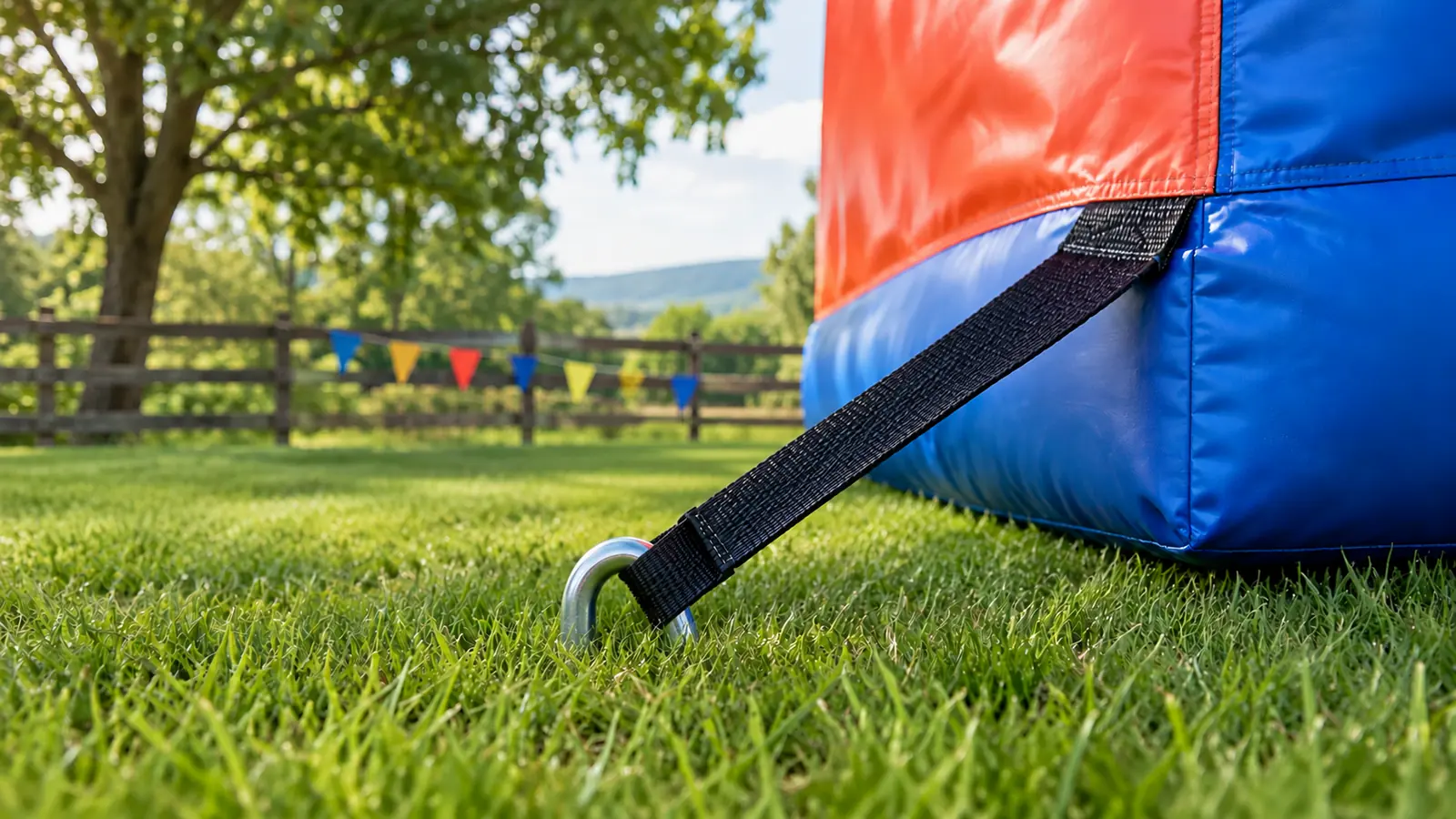
A black webbing strap running from the base of a coral and blue bounce house to a steel J-hook stake in the lawn

Safety guide

Keep it on the ground.

By Chip H. · Updated

Stake every anchor point, stop when the wind picks up, keep an adult watching: the manuals behind the bounce houses on GoJumps agree on that much. Here is what they say about the rest, maker by maker.

We read the owner's manuals for our picks from Little Tikes, Action Air, Bounceland, Sportspower and Pogo, along with what Blast Zone and HeroKiddo publish and the U.S. Consumer Product Safety Commission's own advice. Where a maker gives a number, you'll find it below with the maker's name on it. Where manuals disagree with each other, or with themselves, we say so.

None of it replaces the manual in your box. That one was written for your unit, and where it differs from this page, it wins.

Some links on this page may earn us a commission, at no extra cost to you.

Wind: the number that ends the party

Every maker that prints a number lands between 15 and 25 miles an hour, and the CPSC gives the same range. On a breezy afternoon that difference decides whether the party goes ahead, so look up your own unit's figure before the guests arrive.

MakerStop atWhere it says so
Pogo15 mphPogo safety guide: "15 mph or above"
Blast ZoneOver 15 mphBlast Zone FAQ, for every inflatable it sells
HeroKiddo15 mphJelly Bean combo manual
Little TikesOver 20 mphJump 'n Slide, Jr. and River Race manuals
Action AirOver 25 mphBounce house and water slide manuals
BouncelandOver 25 mphRoyal Palace and Party Castle manual
SportspowerNo figure"Do not use or leave the product outside during windy conditions"
IntexNo figureJump-O-Lene manual: "avoid high winds"
CPSC15 to 25 mph2019 bounce house safety release

A weather app's average hides the gusts, and gusts are the trouble; the Little Tikes, Action Air and Pogo manuals each warn that wind can lift a unit off the ground. A handheld wind meter held where the unit stands gives you a real reading. The CPSC offers a rougher test: if the tops of the trees are swaying, it may be too windy.

If the wind rises mid-party, get everyone out first, then switch off the blower. Pogo says to remove all occupants and deflate if the wind keeps up, and Action Air and Bounceland say to clear the unit the moment it starts to sag.

Anchoring: every stake, every loop

Blast Zone puts it bluntly: your inflatable must be anchored at all times, without exception. Use every stake in the box. Little Tikes packs 8 for the Jump 'n Slide and 4 more for its blower, and H2OGO! packs 9 and 2. Stake the blower too. Little Tikes and Bounceland tell you to, and Sportspower warns that a gust can lift it off the ground.

How the stakes go in

Hook each stake over its loop and drive it until the top sits at or below the grass, where nobody trips on it. That's the method in the Little Tikes, Action Air and Pogo manuals; Bounceland adds that the hook should stay over the loop for as long as the unit is up, and Pogo turns the hook away from the inflatable.

On the angle, the manuals part ways. The Little Tikes Jr. says straight down. The full-size Jump 'n Slide manual manages both, "at an angle for better anchorage" in one place and "Do not drive stakes at an angle" in another. Follow the diagram in your own manual, and check the stakes during play, a step Little Tikes and Action Air spell out.

Soft ground and spare stakes

Little Tikes notes that a stake holds best in hard, dry soil and loses grip in loose or wet ground. Residential stakes are short (Bounceland lists 9 inches, YARD 10), so when one bends or goes missing, replace it rather than leaving a loop empty. Sportspower says its unit must be used with the anchors provided, so ask before swapping on that one.

Commercial vinyl is a heavier class. HeroKiddo's manual calls for stakes 1 inch thick and 18 inches long, driven at least 16 inches deep, and Tucson's fire department sets 18 inches as the minimum for rental inflatables.

Concrete, sand, turf and indoors

Hard ground is out for nearly every unit we list. Concrete and asphalt are ruled out by Little Tikes, Action Air, Bounceland, Sportspower, Intex and HeroKiddo, and Blast Zone asks you not to use any inflatable on concrete or hard surfaces. Most want the ground level as well: Action Air and Bounceland say no slopes, and Sportspower wants the site completely flat.

Sportspower allows sand, along with grass and play bark. Artificial turf isn't covered in any manual we read, and a stake needs soil under it, so ask the maker before you set up on it.

Weights instead of stakes

A few makers allow weights. Pogo says to secure the unit with sand or water bags and extra tether straps on concrete or indoors, and Blast Zone allows sand bags for weighted anchoring. HeroKiddo sets the figure for its commercial combos: 50 pounds of sand per bag and at least 200 pounds at each anchor point. If your manual doesn't mention weights, don't improvise them.

Indoors

Little Tikes and Action Air label their bounce houses for outdoor use only. The pump-up Intex Jump-O-Lene is sold for indoor use, kept away from windows, stairs, glass doors and sharp corners; the toddler page has the indoor picks.

The rules every manual repeats

The CPSC estimated more than 18,000 emergency room visits tied to bounce houses in 2018. Most of what follows is how to stay out of that number.

An adult watching, the whole time

Little Tikes asks for "constant, competent adult supervision" with every part of the unit in view. Pogo wants an adult on hand at all times, and so does every other manual we read.

The headcount on the label

Limits run from 2 children (the Little Tikes Jr. and the Intex) to 6 or more on the biggest units, and the per-child caps in the manuals we read run from 60 to 120 pounds. Every card on GoJumps shows its unit's limit, and the label on the unit has the final word.

Similar sizes together

Match them by size. Little Tikes, Action Air, Sportspower and Pogo ask for it, and so does the CPSC. A 4 year old and a 10 year old shouldn't share a turn, however hard the 4 year old argues the point.

No flips, no wrestling

No flipping and no wrestling: Little Tikes, Action Air, Sportspower and Pogo say it in near-identical words, and Little Tikes and Action Air add no climbing on the walls. Shoes and glasses come off, pockets get emptied of anything hard or sharp, and food, drink and gum stay outside.

Rain, nightfall and heat

Out of the rain, say Little Tikes, Action Air and Pogo. Action Air and Bounceland say not to leave a unit inflated overnight, and Little Tikes wants its water park drained after use and never left full overnight. HeroKiddo says to stay off in direct sun above 90°F; Pogo wants temperatures above 40°F.

If it starts to sag

Get everyone out, then look for the cause: a loose blower tube, a tripped GFCI plug or a power cut. Little Tikes' blowers have a reset button on the plug, and the blower guide covers the rest.

With water, someone on duty

Water slides add a drowning risk. Little Tikes puts it plainly: "Drowning occurs silently and quickly. Assign an adult to supervise the water park." Action Air warns that children can drown in very small amounts of water, and says to empty the pool when it's not in use.
The two-minute check

  1. Wind. Look up your unit's limit, then check the wind where it stands.
  2. Space. Walk the clear zone, 6.6 feet (2 meters) all round on most units, with no fence, branch or wire inside it and nothing overhead. Yard Fit has the figure for every unit we list.
  3. Stakes. Every one in, hooked over its loop, top at ground level, and the blower staked as well.
  4. Power. Blower on a GFCI outlet within reach of its own cord, intake clear of leaves.
  5. Kids. Shoes off, pockets empty, similar sizes, and no more than the label allows.
  6. You. One adult watching, for as long as anyone is jumping.

Worth adding to the box.

Spare stakes, weights for the units whose makers allow them, and a way to read the wind. None of it replaces what came in the box.

Spares for the bag

FEED GARDEN 12 Inch J-Hook Rebar Stakes, 16 Pack

Length
12 in
In the pack
16
Steel
5/16 in ribbed rebar
Head
J hook

Longer than the 9 and 10 inch stakes Bounceland and YARD pack, with a hook that catches the loop. Keep a few in the storage bag: a stake that goes missing leaves an anchor point empty, and the manuals want every one of them used.

View on Amazon

For loose or sandy soil

Homwin 18 Inch J-Hook Rebar Stakes, 16 Pack

Length
18 in
In the pack
16
Steel
3/8 in rebar
Head
J hook

Half again as long as the 12s and thicker, for ground where a short stake pulls out. Little Tikes notes that loose or wet soil cuts a stake's grip; HeroKiddo's commercial units call for thicker stakes than these.

View on Amazon

Where the manual allows weights

Hullaballoo Deluxe Vinyl Sand Bags, 4 Pack

Holds
50 lb each
In the pack
4
Vinyl
18 oz
Tie-down
Metal hook

Pogo says to use sand or water bags on concrete or indoors, and HeroKiddo wants 200 pounds at each anchor point: four of these, filled. Most residential manuals rule out hard ground altogether, so check yours before buying weights.

View on Amazon

Wind, measured

HoldPeak 866B Handheld Anemometer

Range
0.67 to 67.1 mph
Readings
Max, min, average
Units
mph, km/h, knots
Mount
Tripod thread

A wind limit is only useful if you know the wind where the unit stands. This one reads in miles per hour and holds the maximum, so a gust shows up even if you looked away when it came through.

View on Amazon